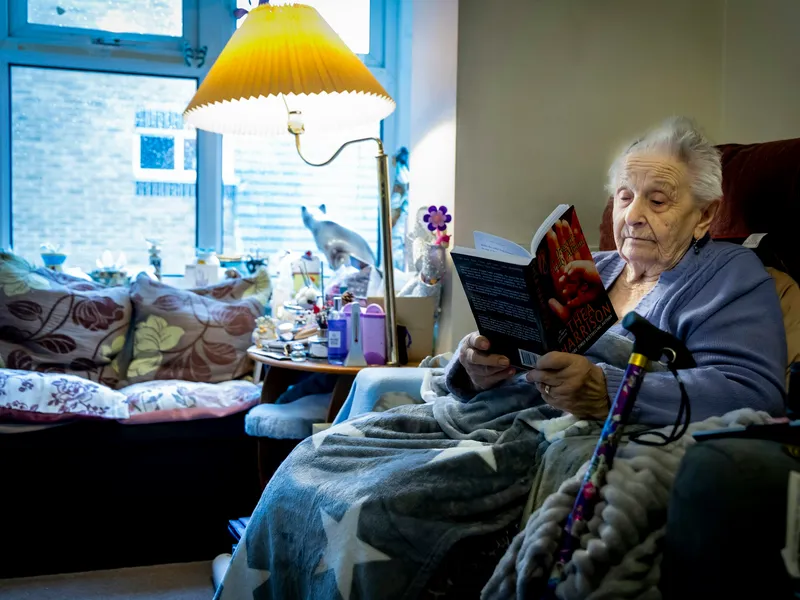
Most people living with dementia live at home, not in long-term care. This guide is about what helps in a house, on an ordinary Tuesday.
Start from what the behaviour is for
Nearly every difficult moment in dementia care is communication using a vocabulary that has been taken away. Before asking how to stop a behaviour, ask what it is trying to say.
The usual answers are unglamorous: pain, needing the toilet, too hot, too cold, too much noise, too many questions at once, hunger, boredom, fear. A person pacing at the door at 5pm is usually not “wandering”: they are trying to go somewhere they have gone at 5pm for forty years.
Practical version: when something starts, run through pain, toilet, hunger, thirst, temperature and noise before anything else. Most of the time it is one of those.
Do not argue with a false belief
If your mother says her mother is coming to visit, telling her that her mother died in 1987 makes her experience the bereavement again, now, with no warning.
Join her where she is, then move on. “Tell me about your mum.” It feels like lying. It is not: it is choosing which truth matters more in that moment, and the answer is almost never the calendar.
Routine does real work
Same order, same times, same words. Familiar routine helps in a way medication cannot, because it removes the need to work out what is happening from first principles many times a day.
This is also why a rotating cast of caregivers is so damaging. Every new face means starting from nothing, and the resistance that follows gets written down as “difficult behaviour” when it is a reasonable response to a stranger in the house.
Personal care is where it goes wrong
Bathing is the most common flashpoint, and usually for reasons nobody explains:
- The bathroom is frightening. Hard surfaces, echo, cold, a dark bathmat that reads as a hole in the floor. Warm the room, use contrasting colours, remove the mat.
- The person does not understand what is about to happen. Say what you are doing before each step. Every step, every time.
- Being undressed by someone is humiliating. Keep the person covered. Wash under a towel. Never carry on a conversation over their head.
- Timing is wrong. Wash at the time of day the person is at their best, not when it suits the schedule. If mornings are terrible, wash in the afternoon.
If a wash becomes a fight, stop. A missed bath is a small problem. A person who now associates the bathroom with being forced is a large one.
Sundowning
Confusion and agitation typically peak in the late afternoon and early evening, which is also when family caregivers are most depleted. What helps:
- more light, earlier, before the afternoon dip;
- a calmer, quieter environment from about 3pm, television off;
- activity earlier in the day so the person is genuinely tired but not exhausted;
- a snack, since hunger is a common and easily missed trigger;
- limiting caffeine after lunch.
Covering specifically 3pm to 7pm with a caregiver changes what an entire household’s day feels like, at a fraction of the cost of round-the-clock care.
Safety, without turning a home into an institution
Focus on the small number of things that cause serious harm: the stove, the stairs, the front door at night, medication, and the car.
- Stove isolation switches and automatic shut-off devices are inexpensive and effective.
- A contrasting handrail on both sides of the stairs helps more than removing the stairs.
- Door alarms are usually better than locks. Locking someone in is not the answer: it takes away their freedom and can trap them in an emergency.
- Driving is the hardest conversation. Raise it with the family doctor before it becomes a crisis.
The BC support that is free
Alzheimer Society of B.C.: the First Link dementia helpline, education sessions, Minds in Motion, and support groups across the province. Free. If you read only one thing on this page, ring them.
Family Caregivers of British Columbia: a provincial caregiver support line, peer support groups and practical guidance. Free.
Your health authority’s home and community care team: assessment for publicly funded home support, adult day programmes and respite, including facility respite beds.
HealthLink BC: 8-1-1: a nurse, free, at any hour.
Adult day programmes: genuinely underrated. A structured, social day out for the person, and a reliable block of hours for whoever cares for them.
Look after the person doing the caring
Family members carry most dementia care, often alongside a job. Respite booked in advance, while things are still under control, works. Respite arranged in crisis rarely does, because by then the person needing care has never met the caregiver and nothing has been handed over.
When home stops being the right answer
Home is not always right, and pretending otherwise does nobody a service. The signals that usually matter:
- care needs exceed what can be safely delivered by the number of people available;
- the person is repeatedly unsafe despite reasonable adaptation;
- night-time needs mean nobody in the household is sleeping;
- the family caregiver’s own health is failing;
- the person is distressed at home rather than comforted by it.
That last one matters most and gets weighed least. Familiar surroundings help, until the surroundings stop being familiar, at which point the argument for home has quietly gone.
If you want to talk it through, call us. We will tell you honestly if the answer is an adult day programme and the Alzheimer Society rather than us.